APPLICATION SCOPE

Freudenberg Performance Materials across technical end uses

Application names are starting points, not performance guarantees. The same process family can yield different basis weight, porosity, tensile behavior, surface character and conversion response, so the exact construction remains central.

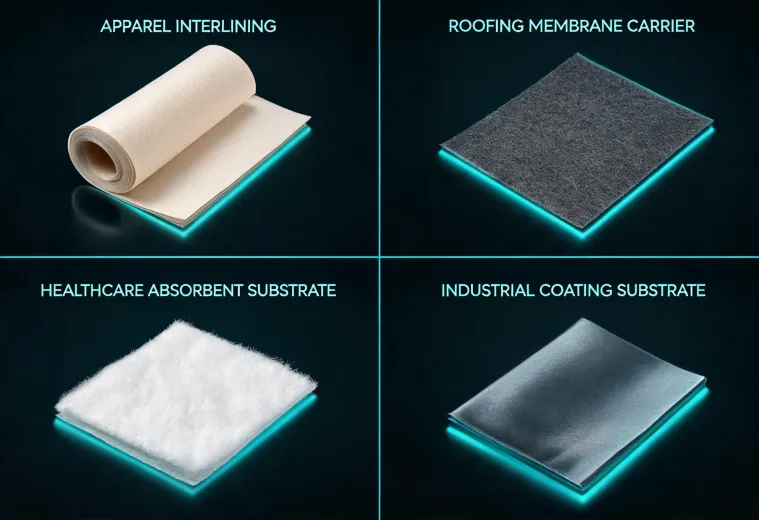
Technical nonwoven end-use sample set

FOUR REVIEW CONTEXTS

Translate end-use conditions into material questions

AF

Apparel and footwear components

Interlining or technical layer selection can require composition, basis weight, hand, drape, bonding response and care-condition review. An OEKO-TEX or other statement must remain tied to its exact product and current scope.

Not covered: finished garments, retail footwear or unrelated consumer brands.
BC

Building and construction

Roofing carriers, acoustic layers or other construction substrates call for dimensional stability, thermal processing compatibility, tensile or tear method, impregnation behavior and long-term assembly context.

Not covered: a universal durability value across Terbond or Texbond grades.
HH

Healthcare and hygiene substrates

Material discussions can cover fluid handling, softness, integrity, porosity, cleanliness and converting requirements. Healthcare application language refers to a material component and does not imply a finished device.

Not covered: clinical outcome, sterility or device approval without specific evidence.
IM

Industrial manufacturing

Coating substrates, separation layers and converted technical textiles may require basis weight, surface uniformity, air permeability, chemical exposure, calendering or lamination compatibility and roll-format details.

Not covered: complete industrial assemblies or finished systems.

SELECTION TRADE-OFFS

Method and material choices change the evidence needed

A recycled feedstock target may support circular-material objectives, while virgin feedstock may simplify some consistency requirements. Neither route is automatically preferable: source evidence, color or property stability, availability and final construction all matter.

Lamination can combine functions across layers, while coating can place a selected function at the surface. The applicable comparison depends on hand, porosity, added mass, conversion temperature, durability, end-of-life route and test method.

Application questionInput to defineEvidence to requestBoundary
Web uniformityFormation route, polymer or fiber, g/m², widthGrade specification and stated tolerance methodVisual uniformity does not establish filtration or barrier performance.
Mechanical handlingConverting tension, temperature, line speed and geometryTensile, tear or dimensional-stability method relevant to the assemblyA result from one direction or conditioned specimen is not universal.
Fluid or air movementLayer structure, pore requirement and service mediumNamed permeability, absorption or filtration method with unitsDo not substitute a finished-system rating for base-media data.
Recycled contentPolymer source, percentage target and product gradeCurrent claim evidence and chain-of-custody scopeRecycled content does not by itself prove recyclability or lower impact.
Added finishCoating, lamination, impregnation or calendering needFinished-construction document and conditioning protocolBase-web data may change after conversion.

Match the application to a testable construction.

State the end use, service environment, basis weight, width, added process, method and evidence threshold. Product and plant applicability must then be confirmed by the official source.